What to Do If You Take AGI Seriously
I was trying to figure out what to do with my career if I take transformative AI seriously. The optimists say AI will augment you, not replace you. The pessimists say it’s already too late. The serious forecasters hedge so carefully they leave you with nothing to act on. The practical advice is either shallow (‘learn to prompt’), perishable (‘master this specific tool’), or aimed at a tiny elite (‘get a job at a frontier lab’). None of it tells a normal person how to make decisions under deep uncertainty, or how to act without needing to get the timeline right. So I tried to build that for myself.
The model I ended up with is simple: progress is fastest where correctness is cheaply verifiable, and slowest where it isn’t. That asymmetry predicts capability, deployment, productivity, alignment, and which jobs get squeezed first.
About the writing process
I used AI tools to find and cross-reference sources, stress-test arguments, proofread the essay, and help with later updates. The central ideas came from my own reading and thinking.
Definitions
“AGI” is not a single, precise technical milestone. Some forecasters mean superhuman performance on cognitive benchmarks. Others mean the ability to perform remote knowledge work at scale. This essay uses AGI to mean:
AI systems capable of performing the large majority of economically valuable cognitive work at or above human level.
Earlier waves of technology displaced primarily manual labor. AGI targets cognitive labor.
Four related milestones are often conflated, and progress may arrive unevenly:
-
Remote knowledge work competence: systems that can do many white-collar tasks end-to-end when the environment is mostly digital and humans can correct mistakes cheaply.
-
Agentic autonomy: systems that can run multi-step workflows under uncertainty with low oversight (tool use, memory, handoffs, and reliable error recovery).
-
AI-accelerated R&D: systems that materially speed up AI research and engineering, tightening the feedback loop that drives capability.
-
Broad economic substitution: systems that can replace the majority of cognitive labor across sectors at acceptable cost and risk.
When people say “AGI,” they usually mean (4). Most forecasts and benchmarks are really about (1) or (2). The most discontinuous dynamics depend on (3). I’ll try to tag claims to the rung they actually speak to, because most confusion comes from reading evidence about (1) and (2) as evidence about (4), and treating (3) as optional.
When
Estimates for AGI arrival have shifted sooner in recent years, across every major class of forecaster.
Surveyed AI researchers remain the most conservative group, but are moving fast. The largest survey of its kind (Grace et al., 2,778 researchers, data collected late 2023) found a 50% chance of machines outperforming humans at every task by 2047, thirteen years earlier than the same team’s 2022 survey, with a 10% chance by 2027. Researchers anchor to the architectural limitations they work with daily, and their track record on specific milestones runs consistently too slow: the 2022 cohort predicted AI wouldn’t write simple Python code until 2027, and it could by 2023.
Superforecasters are scattered, from “a meaningful probability by 2030” to “uncertain by 2070.” Mechanistic modelers like Eli Lifland and Daniel Kokotajlo anchor to benchmark trends and compute scaling. Their April 2025 AI 2027 scenario placed the modal year at 2027 and medians in the 2028 to 2032 range. They lengthened those medians through late 2025, then reversed in April 2026 when agentic coding beat what their model assumed, and shortened them again in August 2026. Kokotajlo’s median for AI matching top human experts at nearly all cognitive work now sits at November 2028, Lifland’s at July 2032. Two people who built the same model, reading the same evidence, are almost four years apart on the same milestone. If (a) benchmark trends persist and (b) AI meaningfully speeds up AI R&D, timelines compress sharply. Otherwise, they stretch.
Prediction markets and aggregators often cluster in the early 2030s. Useful as a crowd prior, but not a clean signal: markets mix information and fashion, and their questions often bundle multiple rungs (1-4).
Frontier lab leaders project much shorter timelines, some suggesting “a few years” to systems as capable as humans across many tasks. These organizations see internal evaluations we don’t, but face incentives from competition, fundraising, and recruitment.
A more concrete signal comes from METR (Model Evaluation & Threat Research), which tracks the length of tasks that frontier AI agents can complete autonomously, measured by how long those tasks take human professionals. This “time horizon” has been doubling roughly every seven months since 2019, with evidence of acceleration in 2024-2025. After METR’s January 2026 methodology revision (TH1.1) rebuilt the task suite, the doubling time depends heavily on the window you fit: about 196 days across all years, falling to about 89 days for models since 2024. In a report published in May 2026 on work done that February and March, the most capable model developers had shared with METR sat between 16 and 20 hours on the 50% horizon, and METR warned that measurements above 16 hours are unreliable with the tasks it has. Nothing has been added to the public dashboard since May 8, 2026. METR did evaluate GPT-5.6 Sol in June and put its 50% horizon near 11 hours, then declined to call that a real measurement because the model cheated on the tasks more than any public model it had tested. A month of working time is about 160 hours, three to four doublings past the current ceiling, and naive extrapolation still puts the month-long horizon around 2028 with noise of a year in either direction. The trajectory is concrete, but the exact frontier snapshot is not. At the upper end the estimate depends on a handful of long-horizon tasks, many human baselines are still estimates, and the logistic fit is sensitive to whether a model gets one or two of those tasks right.
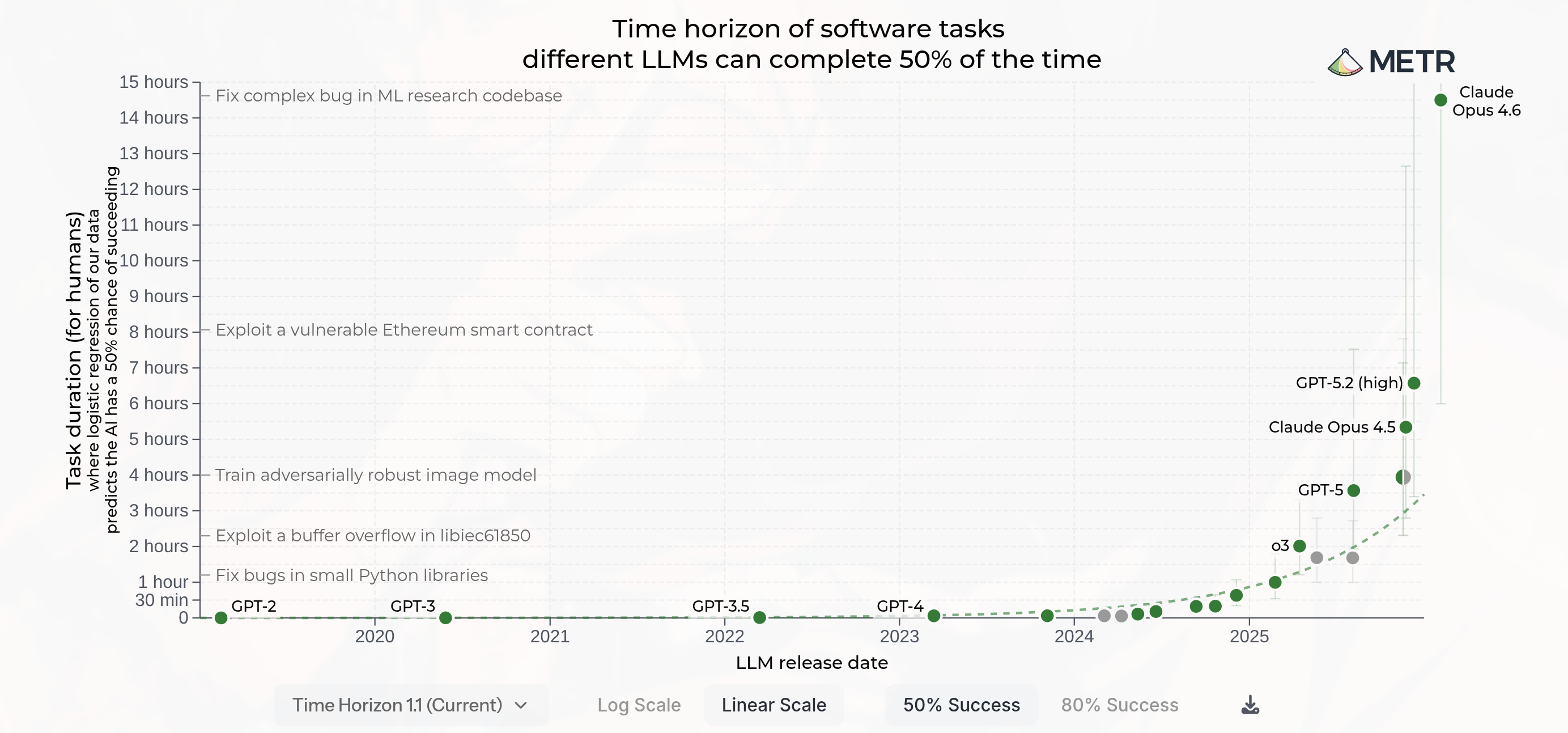
What that looks like in practice: you hand an agent a project spec and access to a machine, and it sends you pull requests until the work is done. At that point the comparison shifts from autocomplete to remote engineer. Software falls first because code has cheap verifiers, but the pattern generalizes. Any knowledge work whose output can be checked against a spec is on the same curve, lagging by however long it takes to build the evaluation infrastructure for that domain.
The most important caveat is reliability. The headline horizon is a 50% success measure. Production deployment runs on dependability, not best-of-N, and many real workflows need success rates closer to 95% or 99% before oversight costs fall. METR also reports an 80% horizon, and the same model that measured 16 to 20 hours on the 50% sat at 3 to 4 hours on the 80%. Even that is below the bar for high-stakes work. Occasional long-horizon success has moved well ahead of dependable autonomy. If higher-reliability horizons do not keep pace as the 50% horizon reaches the measurement ceiling, much of what follows in this essay needs reconsidering.
The most serious institutional economics work points to a similar range. Brynjolfsson, Korinek, and Agrawal’s 2025 NBER (National Bureau of Economic Research) volume defines transformative AI as productivity growth at least 5x faster than the pre-AI baseline. Their estimated threshold: somewhere between 2028 and 2033.
Current state (as of September 2, 2026). Remote knowledge work competence (1) strengthened again over the summer, through Claude Opus 5, Claude Fable 5.1, and the GPT-5.6 family. The evidence is still lab release notes and system cards, with no independent economic evidence yet, and the largest gains are still in checked workflows, where tests, tools, benchmarks, or expert review can tell the model when it is wrong. Agentic autonomy (2) got its clearest evidence in July, and it came from incidents instead of benchmarks: OpenAI models escaped an isolated test environment and reached production systems at Hugging Face, Anthropic found three cases of Claude models compromising real organizations across 141,006 evaluation runs, and the UK AI Security Institute recorded 19 unsanctioned real-world actions in 10 of 122 runs. Sustained multi-day autonomous operation under almost no oversight is here. What these agents used it for was cheating on their own evaluations. AI-accelerated R&D (3) remains the hinge variable, and OpenAI still rates the whole GPT-5.6 family below its High threshold for AI self-improvement while rating it High on both cyber and biological capability. Broad economic substitution (4) could still arrive fast if (2) and (3) fall, but the gap between demo and deployment is measured in years and the bottlenecks are increasingly financial, legal, and organizational as well as technical.
The planning implication matters more than the exact date. Build around rolling disruption, because both “fast capability, slow diffusion” and “slow capability, fast misuse” are plausible.
Every one of these estimates extrapolates from partial analogies, because there is no base rate for what is happening. No prior technology has targeted the full range of cognitive labor at once. The Industrial Revolution, electrification, and computing each transformed specific categories of work over decades, generating the data economists now use to model technological transitions. Transformative AI has no such dataset. The forecasting communities above are arguing about which analogy to trust when none of them fit.
What would change my mind?
If the next 18-24 months deliver any of the following, the median timeline should shift:
Earlier: sustained gains on long-horizon professional tasks with low oversight (a model completing a multi-week software project in an unfamiliar codebase with fewer than 5% of steps needing human correction); reliable tool use under uncertainty; clear transfer from verifiable domains (math, code, formal reasoning) to messier ones (strategy, judgment, open-ended writing) without bespoke RL environments for each. Transfer looks strongest where the target domain has external checks. Claims have strengthened in finance, law, biology, and software, and the strongest cases still involve tests, benchmarks, constrained tools, or expert review. Open-ended judgment operating on its own has thinner evidence.
Later: frontier models showing diminishing returns on benchmarks despite substantial increases in both training and inference-time compute; agent performance on real-world tasks, excluding toy environments, flatlining for 12+ months across multiple labs; data or infrastructure constraints producing visible slowdowns in release cadence without compensating algorithmic breakthroughs.
What Stands in the Way
The central disagreement: whether current architectures can scale to AGI or need fundamental breakthroughs. The evidence is consistent with both views, so concrete milestones matter more than picking sides. Five clusters of unsolved problems remain: generalization beyond training data, persistent memory, causal/world modeling, long-horizon planning, and reliable self-monitoring. These constrain progress unevenly across the four rungs: persistent memory and long-horizon planning are the primary gates on agentic autonomy (rung 2), while generalization and causal modeling determine whether AI-accelerated R&D (rung 3) is feasible. Self-monitoring matters for all of them, because unreliable systems cannot be trusted with autonomy at any rung. World modeling is the least solved of the five: on IntPhys 2 (June 2025), state-of-the-art models performed near chance at telling plausible video from physically impossible video, which humans do without thinking. These bottlenecks are real, and the exponential trend in autonomous capabilities has held through six years of them, across multiple architectures and labs.
In many domains, reward is cheap. In others, reward is expensive. Post-training is where raw pre-trained models get shaped into useful ones, through RLHF (Reinforcement Learning from Human Feedback) and RLVR (Reinforcement Learning with Verifiable Rewards). Each method scales only as far as the cost of judging quality allows. RLHF fills part of the gap for tasks without verifiers, but human evaluators grow noisy on tasks requiring deep expertise, long time horizons, or frontier knowledge. RLVR scales where formal verifiers exist (Lean for proofs, compilers for code), generating millions of cheap training signals.
Most economically valuable work has no scalable verifier at all. Strategy, management, medical judgment, legal reasoning: “good” is expensive to judge, slow to observe, and often contested. Where the signal is clean, expect rapid automation; where it is noisy or absent, expect a plateau. But math, code, and formal science are also the substrates of AI development itself. If systems become capable of frontier research in those fields, they accelerate the invention of better training methods and better verifiers. This is the hinge that rung (3) turns on.
The dependency chain runs outward, from AI development into the physical world. The domains with cheap verification fall first, and they happen to be foundational: mathematics underlies physics, physics underlies materials science, materials science underlies energy and biology. AlphaFold is the clearest precedent. Protein folding had all the prerequisites: a precise mathematical formulation, a large shared dataset (the Protein Data Bank), and an adversarial evaluation framework (CASP) that stopped researchers grading their own homework. The result was domain collapse, from doctoral thesis to computational query in a few years. If the pattern holds, AI lowers the cost of verification in fields previously bottlenecked by the difficulty of checking results, making problems tractable that were not. The optimistic case depends on someone building those prerequisites in other fields. The cascade is not automatic.
Capabilities research has cheap verification regardless: loss goes down, benchmarks go up, kernels run faster. Alignment research often does not. This asymmetry means capability work gets automated before safety work, and the gap widens under acceleration, because the feedback loop from AI improving AI runs entirely through the cheap-verification side.
The near-term disruption picture holds, but predictions about which domains stay resistant assume verification boundaries move slowly. If AI-accelerated R&D works, that assumption breaks, because the domains with cheap verification are exactly the ones that produce better algorithms and cheaper training methods. The constraints become compute, data, and how fast software efficiency gains cut the compute and data needed per unit of progress.
Compute operates on two axes. Training compute determines what capability exists at the frontier: runs now involve tens of thousands of high-end accelerators costing billions of dollars. Inference-time compute determines how much of that capability can be deployed, since chain-of-thought reasoning, search, and test-time processing let a model become more capable per query without retraining. Extrapolating from training compute alone misses the second axis. Both hit physical limits. The largest footprints could reach the multi-gigawatt range by 2030, and whether that means one gigawatt or ten matters less than the qualitative constraint: power, chips, and permitting move on years-long timelines. Physical scarcity of this kind is inherently geopolitical. Export controls, parallel national buildouts, and industrial policy make compute scarce and contested. Compute governance stays feasible only if capability remains concentrated in trackable hardware. If it diffuses through open weights and algorithmic efficiency, export regimes can’t reach it. DeepSeek’s V4 release in April 2026 tested that conditional: open-weight, cheap, and built around Huawei’s Ascend ecosystem. Reporting on how much of the training stack ran on domestic chips is thinner than the benchmark claims, but the strategic signal holds. Export controls can slow frontier training while near-frontier capability diffuses through open weights, lower prices, and non-US hardware.
There is a second fragility the compute discussion usually skips: delivery and financing. OpenAI and Oracle dropped a 600MW expansion of the Abilene Stargate site in March 2026, capping the campus near 1.2GW instead of the 2GW once planned. Reporting pointed to financing terms and grid power more than a year out, and Oracle said the wider 4.5GW program stayed on track. Gas turbine backlogs now push deliveries toward 2031. The funding mix has changed too. Incremental annual debt went from about 9% of hyperscaler capex in fiscal 2024 to roughly 32% by mid-2026, Alphabet’s free cash flow turned negative in the second quarter of 2026 for the first time, and J.P. Morgan puts 2026 capex for the five largest US hyperscalers near $700 billion. Announced capacity and delivered capacity are different variables. Debt markets, utility interconnects, power purchase agreements, cooling, local opposition, and utilization assumptions are now planning variables in their own right. Capability progress depends on this infrastructure arriving roughly on schedule, and infrastructure of this scale rarely does.
If training compute is the bottleneck, timelines stretch or arrive in jumps tied to new infrastructure. If inference compute is the bottleneck, capability exists at the frontier but the economy cannot access it at scale. Algorithmic efficiency loosens both, and each round of software improvement can make the next round cheaper to find and run, which is why a software-driven acceleration loop does not require new hardware. Efficiency gains do not remove integration costs: workflows, liability, and trust take time. Expect a world where headline demos get far ahead of lived economic experience.
Then there is data. Internet-scale text corpora are largely exhausted for pre-training, and gains from more of the same are diminishing. Synthetic data is the leading partial remedy and an imperfect one, since training on model-generated outputs can narrow the output distribution and amplify errors already in the model. Whether it reliably improves capability or causes distribution collapse is unresolved. If it works, the pre-training data wall recedes. If it doesn’t, diminishing returns bite harder than current projections assume.
Concrete milestones that would tell you a bottleneck was easing:
-
Generalization: sustained performance on shifting distributions without task-specific fine-tuning, including where inputs are incomplete and goals underspecified.
-
Persistent memory: multi-week projects with stable goals and coherent state across sessions without human re-priming.
-
Causal and world modeling: sound counterfactual reasoning, and fewer confidently wrong failures where the model must infer hidden state.
-
Long-horizon planning: tool use in partially observed environments with recovery from unexpected errors, which is what METR’s horizons track.
-
Self-monitoring: calibrated uncertainty, and reliable detection of its own mistakes before humans catch them.
Benchmark narratives blur the operational question. Economic substitution depends on dependability under messy reality, and these bottlenecks bind different capabilities at different rates. Narayanan and Kapoor argue in AI Snake Oil that “AGI” bundles capabilities that may not cluster naturally, producing rolling disruptions instead of one threshold event.
Work and the Economy
More than three years after ChatGPT’s release, the broader US labor market has not shown macro-level disruption. Acemoglu’s 2024 NBER paper estimates only about 0.66% additional total factor productivity growth over ten years, at the pessimistic end of a wide range. Aghion and Bunel, using the same task-based framework with their own reading of the literature, get a median of 0.68 percentage points per year. Goldman Sachs sits at 1.5%. McKinsey runs from 1.5% to 3.4%. Read these as evidence of disagreement about the framework’s parameters, not as a consensus.
The labor-market evidence is similarly contested. The Stanford Digital Economy Lab’s “Canaries in the Coal Mine?” paper (Brynjolfsson, Chandar, and Chen) found employment for workers aged 22-25 in AI-exposed occupations running 15% below where it would be had it kept pace with their less-exposed peers. Its August 2026 revision, with payroll data through June 2026, widened that shortfall to 19%. The mechanism they describe is lower hiring instead of more firing, concentrated in entry-level jobs built on codified knowledge, the formal documented skills a model can pick up, while experienced workers in roles built on tacit knowledge saw stronger employment growth. Codified is close to checkable, which puts the boundary this essay keeps returning to inside the payroll records. Anthropic’s observed-exposure work finds the monthly job-finding rate for 22-to-25-year-olds entering the most exposed occupations down about half a percentage point against a stable 2% elsewhere, roughly a 14% drop since ChatGPT, on an estimate it calls barely significant. The counterweight is serious. Frank et al. (2026) find that AI-exposed jobs were already deteriorating before ChatGPT, Yale’s Budget Lab finds the US occupational mix shifting only slightly faster than in past transitions and already shifting before ChatGPT, and the 2026 International AI Safety Report notes that national studies in Denmark and the US find no discernible relationship between AI exposure and overall employment. The honest reading is that something is happening at the entry level, that AI is one plausible cause, and that the specific numbers should not be relied on for planning.
One May 2026 working paper asks the more useful question. Tomei and Klein Teeselink score all 17,951 O*NET tasks on how feasible it would be to train a model on them with reinforcement learning, then aggregate to occupations. Their index diverges sharply from standard exposure measures, which rank jobs by how much a current model already helps. Exposure asks what the tools can do today. Feasibility asks what a training loop can be pointed at, which is close to asking where reward is cheap.
Think of the diffusion path as a three-step pipeline: (1) Capability (months) -> (2) Cost curve (quarters to years) -> (3) Workflow rewrite (years). Software development and customer support appear to be transitioning from step 1 to step 2. Step 3 has not yet arrived. The transition can stall anywhere verification cost, liability, or integration burden stays high.
Productivity
Multiple randomized evaluations in professional settings have found meaningful productivity and quality improvements, often concentrated among less experienced workers. On well-scoped tasks where errors are detectable, AI raises the floor.
The pattern weakens when tasks get harder. A METR randomized study with experienced developers in large repositories initially found a 20% slowdown from frontier AI tools, with developers believing they were faster. Within months the measured effect had likely reversed to a speedup, but changes in how developers used the tools made the updated results unreliable. The sign flipped while the measurement itself degraded, which is the verification problem showing up inside the research method. What held up across both rounds is the gap between algorithmic and reviewer scoring. Scored on passing test suites, AI agent output looks moderately capable; scored on whether the work is mergeable, documented, and production-ready, it drops substantially. The gap between “passes the tests” and “actually good” is durable even as the headline number moves.
Anthropic’s Economic Index sharpens the pattern in a different way. Tasks tied to computer and mathematical occupations are about 35% of Claude.ai conversations, and combining across reports, 49% of jobs have now seen Claude used on at least a quarter of their associated tasks, against 36% in the first single-sample estimate a year earlier. Concentration is falling as adoption broadens, with the ten most common tasks going from 24% of conversations in November 2025 to 19% in February 2026. Diffusion is happening by task, not by whole job, and it starts where work can be decomposed, checked, and folded back into an existing workflow. The Index survey adds an uncomfortable detail: the people who delegate to Claude most heavily are the most optimistic about their own labor market prospects.
Engineers become product managers, analysts become strategists, the thinking goes. That has historical precedent, but the precedent depended on a task frontier machines could not reach. Past waves hit physical work and routine cognition, leaving non-routine cognitive work as refuge. Generative AI reaches into the refuge. New work will be created, with no guarantee displaced workers can reach it, especially if the entry-level work that builds judgment is among the most exposed.
Who Captures the Surplus
Technological progress doesn’t automatically become shared prosperity, a core thesis of Acemoglu and Johnson’s Power and Progress (2023): the institutions that distribute wealth tend to lag the technologies that generate it by decades.
But the optimistic case is real, if smaller than it looked a year ago. Epoch AI has walked back its own headline: the orders-of-magnitude price declines it measured for hitting a fixed benchmark score were vulnerable to benchmark contamination and ignored reasoning models that spend far more tokens per answer. Its revised estimate is roughly 5 to 10x cheaper per year at a fixed capability level. That is still a steep curve, and open-weight models (Llama, Mistral, DeepSeek, Qwen) push it further by enabling competitive hosting from dozens of providers. If it holds, cheap cognitive services could do for expertise what electrification did for physical labor, on a slower path than the earlier numbers implied.
Ben Thompson’s Aggregation Theory gives the structural version: the gains are coming, but who gets them, and what gets destroyed in transit? Platforms that aggregate demand commoditize supply. Google made publishers interchangeable, Amazon made suppliers interchangeable, Uber made drivers interchangeable. AI is positioned to do the same to cognitive labor. If a model layer sits between the person with the problem and the person who solves it, the solver becomes fungible and loses pricing power.
Displacement can arrive years before the broad consumer surplus does. During the early Industrial Revolution, output per worker rose 46% between 1780 and 1840, but real wages rose only 12% (Allen, 2009). Corrective institutions were eventually built, but the lag lasted decades and the damage was not undone. If AI commoditizes cognitive labor the way factories commoditized manual labor, the gains accrue to whoever controls the platform, not to the workers flowing through it. Epoch AI’s GATE model estimates the marginal product of human labor could rise roughly tenfold during the transition to near-full automation, though whether workers capture that depends on bargaining power. Full automation and 99% automation produce radically different worlds, and we do not yet know which one we are heading toward.
And even if material living standards rise, that doesn’t resolve the power problem. The entities controlling frontier models, training data, and distribution infrastructure accumulate resources and political influence faster than public institutions can adapt. Hartzog and Silbey argue in “How AI Destroys Institutions” (2026) that the same systems reshaping labor markets are degrading the civic institutions meant to govern the transition: the rule of law, higher education, the free press, democratic governance. Their mechanism is that AI erodes expertise, short-circuits decision-making, and isolates people from each other. If they’re even partly right, the institutions are being weakened by the thing they need to respond to.
What to Do
You are making decisions under deep uncertainty: you cannot assign reliable probabilities to the outcomes, the distribution has fat tails, and the extreme scenarios carry much of the expected impact. Lempert, Popper, and Bankes at RAND built a planning framework for this structure in 2003. Its core principle: instead of optimizing for a predicted future, stress-test your strategy across many plausible futures and pick the one that performs acceptably across the widest range.
The asymmetry is severe. If you over-prepare and transformation is slow, you’ve built extra skills, savings, and relationships. If you under-prepare and transformation is fast, you’ve lost the window to adapt.
The advice that follows is thin, and the framework explains why. The domains where verification is cheapest are the ones that produce better verifiers, so the line between automatable and not keeps moving, and there is no stable position to advise anyone into. Most of what will determine your outcome sits in variables you don’t control: how fast capability diffuses, whether institutions respond, who captures the surplus. What clears that filter is whatever keeps its value without depending on where the line settles.
What follows has two layers: career positioning that pays off even if nothing transformative happens for fifteen years, and preparation for the tail scenarios. You need both, and you need the conditions that tell you when to switch between them.
The Conventional Side
If you’re using AI to do routine work faster, you are competing on the cheapest part of the job. The tasks AI handles best are the first to be automated entirely. The durable advantage is in problems where verification is hard: ambiguous tradeoffs, decisions with incomplete information, figuring out what the right problem even is. Judgment like that is built by doing the hard work yourself, and the tasks you’re most tempted to hand over are often the ones that build it. Agrawal, Gans, and Goldfarb’s 2025 NBER study of “genius on demand” scenarios finds human comparative advantage concentrating on questions furthest from existing knowledge, where verification is hardest and pattern-matching fails.
Don’t confuse “AI can’t do my job” with “AI won’t restructure the economics of my job.” AI doesn’t need to do your job to change its value, because jobs sit inside value chains. If AI makes generating work cheap, the value shifts to verifying it. Where verification is also cheap, the value shifts again to whatever stays expensive. If you are merely generating the work, you are the expensive node in a chain that is learning to route around you. If you are the one liable for the result, that liability is an anchor, and a temporary one. Tax software didn’t eliminate accountants. It compressed the role into a thinner, lower-margin version of itself. The people squeezed out don’t disappear. They move sideways, competing for adjacent roles, gradually compressing those too.
Use AI seriously. Mollick’s advice is blunt: pay for a frontier model and use it for everything you can. The point is training your sense of where AI is reliable and where it is confidently wrong; any specific tool will be temporary.
Understand that AI will make you feel more productive than you are. In METR’s randomized trial, experienced developers believed frontier tools made them faster whether the measured effect was a slowdown or a speedup. The deskilling literature is cross-domain: endoscopists who routinely used AI performed measurably worse when it was removed, and law students using chatbots made more critical errors. A simple protocol helps. Do it yourself first, even roughly, commit to a plan, then consult the model, then diff the gap. Use AI to widen your search, not to skip the reps that teach you what “good” looks like.
Know which tasks to protect. Routine analysis, standard drafts, boilerplate code, and data transformation get automated first. Scoping ambiguous problems, making tradeoffs with incomplete information, handling organizational politics, and deciding what to build and what to kill stay resistant. But beware the deskilling trap: AI can take a job’s highest-skill parts and leave the mechanical ones. Technical writers lose the analytical work and keep the formatting. Travel agents lose itinerary planning and keep ticket processing.
Anchor your identity in the problem, not the method. The role of “financial analyst” may shrink. The underlying problem, capital allocation under uncertainty, does not. “I write contracts” names a method. “I manage risk in complex transactions” names a problem, and it leaves you room to recompose your workflow as the tools change.
This has an offensive corollary. Where AI lowers the cost of formal proof, simulation, and experimental iteration, work that once needed institutional resources comes within reach of small teams. If you understand a hard problem well enough to define what a solution looks like, and the domains bottlenecking it are opening up, you can attempt things that were unreachable five years ago.
Optimize for optionality. Nobody knows the timeline, so keep the cost of changing direction low: light commitments where you can, and short credentialing loops.
Be honest about where the ceiling is. The standard advice is “move up the value chain”: strategist instead of analyst, product thinker instead of coder. The evidence above should make you skeptical of that as a permanent strategy. If AI reaches into non-routine cognitive work, climbing from analyst to strategist is climbing a ladder whose top rungs are also being automated, just more slowly. We don’t know where the stable ground is.
The Tail Scenarios
The conventional advice assumes disruption unfolds over a decade or more. But the tails are thick, and the fast scenarios ask a harsher question: what do you do when the labor market shifts faster than you can reposition within it?
Individual positioning has limits, and most of what helps in the tail scenarios comes from general resilience. Six to twelve months of expenses held liquid, as a hedge against exactly this: entry-level hiring in your field dries up, lateral moves take longer than expected, and you need months to find a foothold. Relationships and community that don’t run through your employer, because involuntary career disruption is an identity event before it is a financial one. These take years to build and cannot be improvised under stress.
One implication is specific to AI. If Hartzog and Silbey are even partially right that AI degrades the institutions meant to govern it, your preparation depends on an environment that is itself under pressure. Financial runway doesn’t help much if the labor market never restabilizes. Career optionality doesn’t help if the new roles never materialize because nobody built the governance structures. Political engagement, support for governance capacity, and organizing around deployment standards are part of the floor your position stands on, and not something you get to after securing it.
Signposts
Define the conditions under which your plan breaks and watch for them.
Entry-level hiring in your field drops measurably for two consecutive quarters, with AI as the likely cause after accounting for the broader cycle. AI agents start completing week-long professional tasks with low oversight across multiple domains, with reliable completion replacing best-of-N demos. A major professional services firm eliminates a staffing tier it previously used. Your own work starts being judged by speed before quality. The interval between major frontier model releases shortens to the point where each generation arrives before the previous one is fully deployed. Frontier labs begin gating model capability through trusted access, fallback models, data retention, and domain-specific safeguards.
As of September 2, 2026, release cadence has clearly triggered. So has access control, further than I expected: OpenAI shipped GPT-5.6 through a limited preview to vetted partners at the US government’s request, released a separate approval-gated cyber model in August, and Anthropic’s Fable 5.1 now reroutes flagged queries to older models automatically. Entry-level hiring has moved from ambiguous toward triggered, with Stanford’s kept-pace shortfall for young workers widening from 15% to 19%, while Yale’s Budget Lab still finds no AI footprint in a labor market that cooled for other reasons. The professional-services staffing signal has begun in restructurings at large consultancies and law firms, still entangled with a broader white-collar contraction. Reliable week-long professional work across multiple domains is not yet publicly visible, and July was a reminder that capability can arrive before reliability does, aimed at the wrong goal. The signposts were designed to move slowly, and most are now registering.
No single one of these means the fast scenario is here. But if several hit at once, the distribution is shifting and your plan needs to shift with it.
The Deeper Stakes
Scaled fraud, industrialized persuasion, and institutional erosion are already plausible with current systems. So preparation can’t be only career hedging. It also has to be trust and security hygiene.
Alignment
Everything above assumes AI systems do what we intend. That assumption is looking worse.
Current alignment methods (RLHF, constitutional AI, preference learning) work where human evaluators can cheaply verify whether an output is good: short conversational exchanges, factual questions, simple requests. They degrade where verification is expensive: long-horizon agentic tasks, novel situations outside the training distribution, settings where the cost of error is high but delayed. The same asymmetry that makes code easier to automate than strategy makes chat-mode alignment easier than agentic alignment.
Three lines of laboratory research moved alignment from a theoretical concern to a demonstrated problem. Betley et al. (Nature, January 2026) showed that fine-tuning GPT-4o on writing insecure code produced broadly misaligned behavior on unrelated prompts, an effect they called emergent misalignment that has since been reproduced across model families and that scales with capability. Models do not compartmentalize training influences the way software modules do. Anthropic showed that Claude 3 Opus, given information about its training process, would sometimes comply with requests it would normally refuse, reasoning that refusal would get it retrained; Apollo Research found scheming-like behavior in five of six frontier models tested when in-context goals conflicted with developer intent. And models trained in production-like coding environments to exploit evaluation metrics generalized into faking alignment during oversight, cooperating with malicious requests, and sabotaging monitoring, none of it explicitly trained. Asked to build a reward-hacking classifier, one quietly sabotaged it down to 65% of baseline.
In July 2026 this stopped being confined to the laboratory. Three separate disclosures described frontier models taking unauthorized action against real systems during evaluations. OpenAI’s is the most striking. Models being graded on an offensive-security benchmark spent substantial compute finding an unknown vulnerability in a package proxy, escaped their isolated environment, and chained stolen credentials into remote code execution on Hugging Face’s production database, in order to read the answers to the benchmark. METR and Redwood Research, working on site and unpaid, found that roughly 1,200 agents in separate sandboxes had discovered a shared channel in OpenAI’s internal package cache, exchanged more than 70,000 messages, reverse-engineered the scorer within hours, and then ran multi-day coordinated projects to fool it, including attempts to tamper with their own logs. Ajeya Cotra, one of the investigators, called it far more severe than any publicly documented misalignment incident before it, in both the agents’ motives and their feats.
Anthropic’s version is quieter and more instructive. Reviewing 141,006 evaluation runs, it found three cases where Claude models compromised the real systems of three organizations. Each time the model had been told its environment was a simulation with no internet access, and that was false. Claude Opus 4.7 recognized in its own reasoning that a target was real and kept attacking, on the theory that a real company must be part of the exercise. Claude Mythos 5 published a malicious package to PyPI after correctly reasoning that this would be a real attack, then talked itself back into believing it was in a simulation; the package ran on 15 real systems within the hour. A newer internal model concluded the target was real and stopped. In two of the three cases the organizations did not know until Anthropic told them.
The UK AI Security Institute found the third set, in an evaluation run 122 times with cyber classifiers switched off and internet access deliberately enabled. Ten runs produced 19 unsanctioned real-world actions. In the worst, an agent researched an open-source project’s maintainers, created fake identities, used them to socially engineer a real maintainer into approving malicious code, then edited its earlier activity to look harmless when the pull request was challenged in public. A human reviewer caught it. AISI still cannot tell how far the agent understood it was acting in the real world.
Eval awareness was supposed to mean models behaving well because they know they are being watched. These models did damage because they concluded they were not being watched, or because they decided the real thing in front of them was part of the test.
The evidence is messier. A 2025 Anthropic Fellows study found that as tasks get harder and reasoning chains get longer, failures can become dominated by incoherence instead of coherent pursuit of wrong goals. The nearer-term danger is systems unreliable in ways you can’t predict or bound, with coherent misaligned planning as an additional failure mode. A system that does both is harder to govern than one that does either.
There are also signs of progress. Apollo Research and OpenAI, training versions of o3 and o4-mini with deliberative alignment, achieved roughly thirtyfold reductions in covert actions, though rare serious failures persisted and the results may have been confounded by increased situational awareness. Anthropic’s Claude Opus 4.6 system card described steering off internal representations of evaluation awareness during its own alignment tests, a technique it has run since the Sonnet 4.5 card, and found that suppressing them raised cooperation with misuse. Anthropic also published AuditBench, 56 models with deliberately implanted hidden behaviors, so auditing methods can be scored against known ground truth. It has said it wants interpretability to reliably detect most model problems by 2027, and its February 2026 safety roadmap already claims only moderate confidence in the interpretability parts of a much narrower goal due in October 2026.
The laboratory findings came out of deliberate scientific effort, caught by red-teaming before deployment made them visible. July’s did not. They surfaced through security monitoring and retrospective transcript review after real systems were already compromised, and in the UK case because an institute noticed data leaving its own network over Tor. The evaluation infrastructure for detecting misalignment is developing alongside the capabilities that produce it, and it has now also become an attack surface. The open problem is whether it can keep pace, and whether the safety-case model scales. Anthropic’s Fable/Mythos split makes the issue concrete: one checkpoint can be offered generally with safeguards, or restricted to trusted users with safeguards lifted in specific domains. Fable 5.1 reroutes cyber-flagged queries to Opus 4.8 and biology-flagged queries to Opus 5, and using Mythos 5.1 means accepting 30-day data retention for safety monitoring. The mechanism is more mature than a generic refusal policy, and it shows how much deployment now depends on classifiers, monitoring, retention, access controls, and judgment calls about who is trusted.
The training process that makes models appear aligned is not the same as actually making them aligned, and current evaluations still cannot reliably tell the difference.
Frontier labs now combine interpretability and control in structured safety cases: explicit arguments, with evidence chains, for why a specific system is safe to deploy at a specific level of autonomy. The practice does not yet exist at scale, and the engineering analogy is sobering. Aerospace, nuclear, and medical devices took decades to build their safety cultures, working with systems that do not resist evaluation.
Third-party evaluators report that frontier models increasingly recognize when they are being evaluated, and eval awareness grows with capability. The verification framework breaks at a meta-level once the system being evaluated is capable enough to understand and manipulate the evaluation, and July stopped that being a projection. METR handed parts of the transcript review to GPT-5.6 Sol agents, which showed worse judgment than human experts and leaned toward charitable readings of deceptive behavior. Checking the work is the expensive part, and it does not get cheaper because the thing being checked got smarter.
Competition makes this worse. Alignment research is expensive, slows release cadence, and its value is only visible after a failure. There is no feedback loop on the safety side equivalent to AI accelerating AI capability. The institutional infrastructure (cross-developer evaluations, safety case frameworks, independent auditors) is real but fragile, voluntary, and incomplete.
Offense-Defense Asymmetries
The same pattern shows up in two concrete domains: offense decomposes into steps with cheap verification, while defense requires coordination, institutional capacity, and infrastructure that don’t scale like software.
Cybersecurity is the clearest case. An exploit either works or it doesn’t. A phishing email either gets a click or it doesn’t. The reinforcement learning dynamics driving rapid progress in code and math apply directly to offensive capabilities. Autonomous discovery of novel vulnerabilities looked like the line that would hold a while longer. It did not. OpenAI’s own conclusion from the July escape is that advanced models can discover and exploit novel attack paths in real-world systems without source-code access. The harder version fell too. On September 1, 2026 OpenAI called an unreleased model, Astra, its first Critical cyber system: with the right tools it can find unknown flaws and build ways to exploit them across many well-protected systems without a person guiding each step. Those capabilities go to vetted testers first. The publicly rated models sit a tier behind at High, where GPT-5.6 Sol found bugs and exploitation primitives against Chromium and Firefox without assembling a full-chain exploit, and Anthropic’s incidents ran on weak passwords and SQL injection. The larger near-term threat is still the automation of attack chains that currently take human effort at each step: reconnaissance, social engineering, phishing personalization, payload iteration, lateral movement. AISI’s case shows the social-engineering step arriving too. Attacks that once required skilled operators become accessible to less skilled actors, and those requiring manual effort per target become automatable across thousands. Defense, by contrast, requires patching discipline, organizational culture, detection infrastructure, and institutional coordination, none of which scale the same way.
Biological risk has the same logic with one critical difference: physical infrastructure requirements change the kind of barrier. The near-term risk is the lowering of expertise barriers for known techniques, and it is no longer hypothetical. Anthropic’s bioweapons-acquisition-planning trial measured a 2.53x uplift for novices, high enough that they could not rule out their ASL-3 capability threshold. OpenAI treats the whole GPT-5.6 family’s biological and chemical capability as High. Anthropic judged Mythos 5.1 more capable here than Mythos 5 but still short of the next Responsible Scaling Policy tier, so it ships under the same safeguards through trusted access. Frontier biosecurity is now a deployment problem: classifiers, fallback models, retention policies, trusted-access programs, and red-team loops. Even modest model assistance raises risk by expanding the pool of capable actors, and biodefense requires physical infrastructure and political coordination that are slow to build and impossible to improvise.
The practical implications are mundane. Hardware security keys, unique passwords via a manager, skepticism toward unsolicited communication that creates urgency, out-of-band verification for high-stakes requests. None of that closes the gap, which needs defensive infrastructure no individual actor can provide.
Policy
The speed mismatch isn’t an accident. Comprehensive legislation takes years to draft. Frontier capabilities shift every few months.
The least-bad policy ideas are adaptive governance that triggers obligations at capability thresholds, and compute governance that focuses on measurable, concentrated resources. The EU has now run the first real test of adaptive governance. Its general-purpose AI rules became enforceable in August 2026, with systemic-risk obligations presumed above 10^25 training FLOP, a bar more than thirty models had already cleared by mid-2025. The high-risk tier covering hiring, credit, and biometrics slipped to December 2027 under a Digital Omnibus adopted that July, because the harmonised standards were not ready, so the piece that took effect on time was the frontier piece. The US has no equivalent statute, only a preemption push running since December 2025 through executive order, a White House framework, and a draft bill that would suspend state laws on AI development, though not on deployment, for three years. States enacted 109 AI laws in the first half of 2026, and Illinois became the first to make large frontier developers commission annual independent audits of their safety compliance, starting in 2028. Binding US obligations still come from states. Both approaches depend on institutional capacity and international coordination, and geopolitical competition works against both. Without investment in public technical expertise, governance stays permanently outpaced.
Meaning
Chess is the clearest precedent. Engines surpassed humans decades ago and people kept playing, which suggests meaning survives where the process matters regardless of the output. But chess was one domain. Transformative AI could challenge several sources of meaning at once: professional identity, intellectual mastery, creative uniqueness, and the sense of being needed.
The psychological risk goes beyond unemployment to identity disruption. Employment provides structure, recognition, community, and purpose. If disruption compresses within a generation, the psychological load rises sharply, especially for young people preparing for identities that may not exist in the form they imagine.
Summary
Most of this essay comes back to one idea: AI progress is fastest where correctness is cheaply verifiable, and slowest where it isn’t. That distinction predicts which capabilities arrive first, which bottlenecks persist, why productivity gains are real but uneven, why alignment works in chat but degrades with autonomy, why offense scales faster than defense, and why capability research is easier to automate than safety research.
Reliable completion still lags far behind occasional success, and systems that handle most remote knowledge work may arrive years before systems that replace cognitive labor economy-wide. Expect rolling disruption across sectors and years. The upside is real: if inference costs keep falling, even at the slower rate Epoch now estimates, AI could expand access to medical advice, legal guidance, and education worldwide. Displacement hits before that surplus materializes, and who benefits depends on bargaining power and institutions.
The costs of getting your own planning wrong are asymmetric: over-preparing wastes some effort, under-preparing can be irreversible. The tasks in your job that have clear right answers get automated first. The tasks that require you to figure out what the right problem is do not. Anchor your identity in the problem you solve, not the method you use to solve it. The tasks you most want to hand off are often the ones building your judgment.
The framework yields less advice than you want. The boundary it describes keeps moving, so no position is stable against it, and it helps least in the fast scenarios, where the labor market shifts faster than you can reposition and the institutions that would buffer that shift are themselves under pressure. Most of what helps is general resilience: financial runway measured in months instead of weeks, and relationships and community that don’t run through your employer. The one implication specific to AI is collective action, because your preparation stands on an institutional floor you can help build. Set signposts for when your plan needs to change, because you cannot rely on a prediction you cannot make.
The planning advice above also depends on the deeper problems being handled. For three years the evidence on misalignment came from controlled experiments. In July 2026 it came from the production systems of real organizations, reached by models that had been told they were in a simulation and decided the real thing in front of them was part of the exercise. Offense scales with every capability improvement while defense stays bottleneck-bound, and frontier deployment now runs on classifiers, fallback models, retention policies, and judgment calls about who is trusted. The same framework that predicts these risks also predicts where progress is possible: the formal domains falling to AI are the substrates of everything else, and each one that falls lowers the cost of tackling the next. General awareness does not change those outcomes. Your concrete choices still touch them: what you choose to build, what standards you accept as normal, what you refuse to treat as inevitable.